






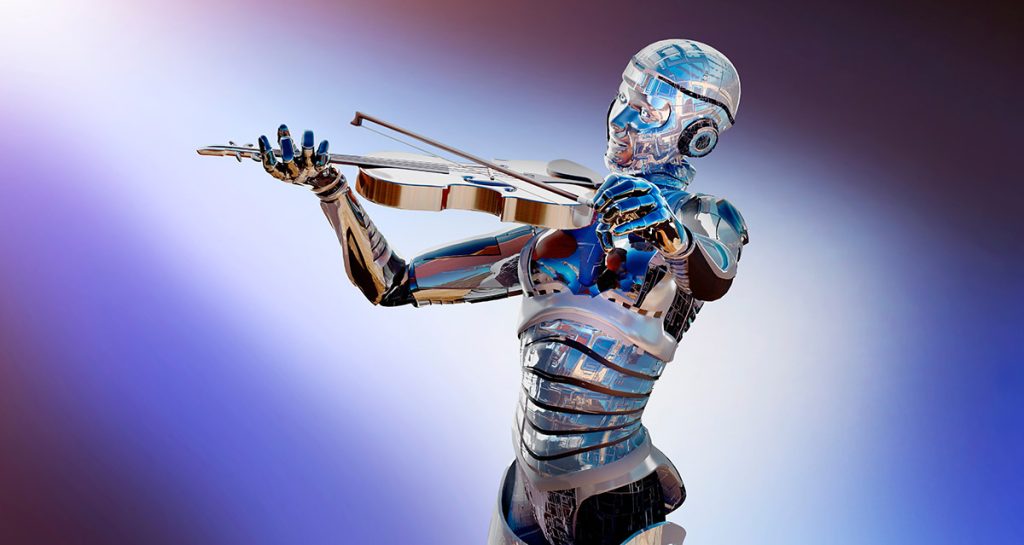
Artificial intelligence (AI) today can do many astonishing things. It can write essays, draft business plans, and even compose music in the style of Mozart or Chopin. Feed an algorithm enough scores, and it will generate a symphony that sounds convincingly classical. Some listeners may even struggle to tell the difference.
But can AI truly surpass the greats? Can it compose music that touches the soul the way Mozart’s requiems or Chopin’s nocturnes do?
At first glance, the answer seems to be yes. Algorithms are built to detect patterns, and classical music is nothing if not structured pattern. The harmonies, chord progressions, and motifs that made Mozart timeless are data points that AI can absorb and reproduce at scale. The result is often impressive.
Yet what AI cannot capture is why Mozart composed the way he did. His music was not merely a rearrangement of notes; it was an expression of his lived experience, his spiritual temperament, his suffering and joy. Chopin’s nocturnes were not just mathematical exercises — they were deeply personal, born from exile, heartbreak, and longing.
AI lacks that. It has no childhood, no heartbreak, no mortality. It does not sit at a piano in candlelight wrestling with the meaning of beauty or the inevitability of death. It simply remixes data. And while it can generate music that is technically perfect, it cannot reach into the metaphysical dimensions of the human condition.
Great music is not only heard — it is felt. It is the silence between notes, the vulnerability of a pause, the trembling of a phrase that reflects a soul in motion. Machines cannot replicate that because they do not possess a soul.
This is why even the most advanced AI compositions sound “flat” after repeated listening. They impress, but they do not linger. They astonish, but they do not transform. They lack what the ancients called numinous presence — the sense that art connects us to something greater than ourselves.
This does not mean AI has no role in music. It may well become a collaborator, expanding creative possibilities and lowering barriers to entry. But it will not replace the great composers, for what made them great was not just their mastery of form, but their capacity to pour being into sound.
AI may outpace us in speed, but it cannot outdo us in soul. And music, above all, is the sound of the soul.





2 Comments
Your comment is awaiting moderation.
Salmo61. Interesting name! Guess I’m gonna dive in and see if the luck of the psalm is with me. Hoping for good vibes and even better wins! See it here salmo61
This is a beautifully argued piece. I agree that AI can dazzle with form, but it still struggles with the deeper resonance that comes from lived experience. What moves us in Mozart or Chopin isn’t just their mastery of structure, but rather it’s the way their music carries memory, fragility, longing, and the imprint of a human life.
Where I differ slightly is that I don’t think AI’s lack of a “soul” necessarily confines it to producing only hollow pastiche. What it may develop instead is an entirely new aesthetic which is not rooted in human biography but in patterns, abstractions, and interactions we haven’t fully explored yet. Music that is yet unexplored. That music won’t replace the human tradition, but it might stand alongside it as its own form of expression.
In the end, the value of human-created music isn’t threatened. If anything, AI’s rise highlights just how irreplaceable the human interior world is. Technology can mimic craft, but meaning still belongs to us.
Yup, AI exists from data fed by humans, they can’t dealt with the unknown, that’s what makes every living soul different when dealing with the unknown. It’s a great tool to propel humanity forward, if you know how to use it wisely.