

The world feels like it is tilting. In recent days, tensions between Israel and Iran have escalated sharply, sending waves of uncertainty across the Middle East. Friends in Abu Dhabi who normally discuss investments and business opportunities now speak in quieter tones. Some have moved temporarily. Others speak about contingency plans. War has a way of shrinking the distance between abstraction and reality. Fear, once theoretical, becomes immediate. But while missiles and military maneuvers dominate the headlines, another shift is unfolding quietly in the background. One that may shape the future of power just as profoundly. The race for artificial intelligence has entered a new phase. And the ethical guardrails are beginning to wobble. When AI Becomes Strategic Infrastructure Recent reports that OpenAI has stepped into a defence agreement with the Pentagon have sparked intense debate. At a purely technical level, such partnerships are not unprecedented. Governments have always worked with private innovators. Aviation, nuclear technology, and the internet itself all emerged through close collaboration between the state and the private sector. But artificial intelligence is different. AI is not simply a technology. It is an amplifier of human power. When embedded into defense systems, intelligence analysis, cyber operations, logistics, and battlefield decision-making, AI becomes something far larger than software. It becomes strategic infrastructure. In the twentieth century, the technologies that shaped geopolitics were steel, oil, and nuclear energy. In the twenty-first century, that role increasingly belongs to data and intelligence systems. And everyone knows it. The Uneasy Signals Inside the AI Community Around the same time as the Pentagon announcement, a senior figure at Anthropic, one of the companies most publicly associated with AI safety, resigned. Resignations in technology companies are common. But context matters. Anthropic was founded by researchers who believed the development of powerful AI required extraordinary caution. The company positioned itself as a counterbalance to the rapid commercialization of AI systems. When figures associated with safety-oriented institutions begin stepping away, observers cannot help but wonder whether deeper tensions are unfolding inside the industry. Is the pressure to deploy AI systems quickly beginning to outpace the commitment to build them safely? We cannot know the internal dynamics of these organizations. But the signals are difficult to ignore. The Public Backlash Shortly after news of the Pentagon collaboration circulated, a wave of criticism erupted online. Calls to “Cancel ChatGPT” began trending globally. Reports suggested dramatic spikes in app uninstallations and negative reviews, while competing AI platforms saw surges in downloads. Public backlash is rarely a reliable indicator of long-term shifts. Online outrage often burns intensely and disappears just as quickly. But this moment reveals something deeper. For the first time, many ordinary users are realizing that artificial intelligence is no longer just a helpful tool for writing emails or summarizing documents. It is an instrument of geopolitical power. And people are beginning to ask uncomfortable questions about how that power will be used. The Real Tension Beneath the Surface For the past decade, the AI industry has spoken extensively about ethics. Alignment. Safety. Responsible deployment. Entire institutions were built around these ideas. Yet today, the development of advanced AI systems is increasingly shaped by a very different force: Strategic competition between nations. When national security becomes involved, the incentives change dramatically. Speed begins to matter more than caution. Capabilities matter more than philosophical reflection. The tension we are witnessing now is not simply about one company or one government contract. It is about the collision between two visions of AI development. One vision prioritizes caution, governance, and ethical alignment. The other prioritizes strategic advantage. History suggests that when these two forces collide, the outcome is rarely gentle. A Qur’anic Lens on Power For those of us who approach technology not only as engineers or entrepreneurs but also as thinkers grounded in ethical traditions, this moment raises deeper questions. In the Qur’anic worldview, human beings are described as khalīfah on earth. Stewards entrusted with responsibility. Power, in this framework, is never morally neutral. It is always a test. Technological power therefore demands not only capability but wisdom and restraint. Artificial intelligence represents one of the most powerful tools humanity has ever created. It has the capacity to transform medicine, education, governance, and economic systems. But it also has the capacity to magnify human error, conflict, and injustice. The question facing us today is not whether AI will reshape the world. It already is. The real question is whether humanity will exercise the moral maturity required to govern it. A Defining Moment We may look back on this period years from now as the moment when artificial intelligence moved definitively from the realm of innovation into the realm of geopolitics. When AI became part of the global architecture of power. If that is the case, then the decisions being made today will carry consequences far beyond corporate profits or product launches. They will shape the moral architecture of the technological age we are entering. And perhaps that is why this moment feels so unsettling. Because beneath the headlines, something profound is happening. Humanity has built an extraordinary new instrument of power. And we are only beginning to understand what it means to hold it.

The Week in AI: Power Plays, Cosmic Ambitions, and Billion-Dollar Bets
Sorry we have been quiet.. it has been a busy time in the office. Negotiations. Partnerships. Pivots. Nothing unusual really.. Likewise it’s been a restless week in the world of artificial intelligence — where boardroom dramas, trillion-dollar dreams, and orbiting data centers all collide in one dizzying narrative. Here’s the lowdown for you in a nutshell: 1. When OpenAI turned on itself In the latest twist of Silicon Valley theatre, OpenAI’s own co-founder Ilya Sutskever reportedly penned a 52-page memo detailing “patterns of dishonesty and manipulation” in a failed bid to oust Sam Altman last year. Former CTO Mira Murati allegedly provided supporting evidence, even drafting a separate “Brockman Memo” about co-founder Greg Brockman. The AI revolution might be run by machines one day, but for now, human intrigue still steals the show. 2. Google’s cosmic leap: data centers in orbit Google announced Project Suncatcher, a plan to deploy solar-powered TPU satellites by 2027. The promise? Data centers in space that run eight times more efficiently than their Earth-bound cousins. It’s sustainability — with a rocket attached. 3. China draws the digital curtain Beijing moved to tighten control over its AI infrastructure, banning U.S. chips in all state-funded data centers. NVIDIA, AMD, and Intel are officially out of the Chinese market — a sharp reminder that the AI race is as geopolitical as it is technological. 4. Siri’s new brain: a billion-dollar reboot Apple and Google sealed a $1-billion-per-year pact to power the next-gen Siri with Google’s Gemini model (1.2 trillion parameters, if you like big numbers). The focus is on reasoning, summarization, and privacy-centric cloud computing — a polite way of saying Siri finally plans to catch up. 5. The rise of “vibe coding” Collins Dictionary named “vibe coding” as 2025’s Word of the Year — a nod to the growing movement of developers who build applications through natural-language interaction rather than code. The vibe, apparently, is strong enough to change how we think about programming itself. 6. The U.S. flirts with AI infrastructure loans OpenAI’s CFO Sarah Friar floated the idea that U.S. government loan guarantees could support the trillion-dollar expansion of AI data centers. Altman later clarified that OpenAI isn’t directly seeking the funds — but Washington’s interest is enough to make the global cloud industry twitch. 7. Perplexity and Snapchat’s $400-million alliance Snapchat just crowned Perplexity as its official AI search engine starting 2026. The partnership blends cash and equity, sending Snap’s stock soaring by 24%. Consider this the next stage in social-search symbiosis. 8. Michael Burry bets against the AI kings The “Big Short” legend is at it again. Michael Burry reportedly placed $1.1 billion in puts against NVIDIA and Palantir, hinting on X that “sometimes, the only winning move is not to play.” A contrarian move in an industry drunk on optimism. 9. Musk’s trillion-dollar payday Tesla shareholders just greenlit Elon Musk’s record $1-trillion compensation plan, tied to milestones like selling one million humanoid robots and hitting an $8.5-trillion market cap. Even by Musk standards, that’s audacious — part sci-fi, part Wall Street fever dream. Step into the future with us, KhalifAItelligence.com
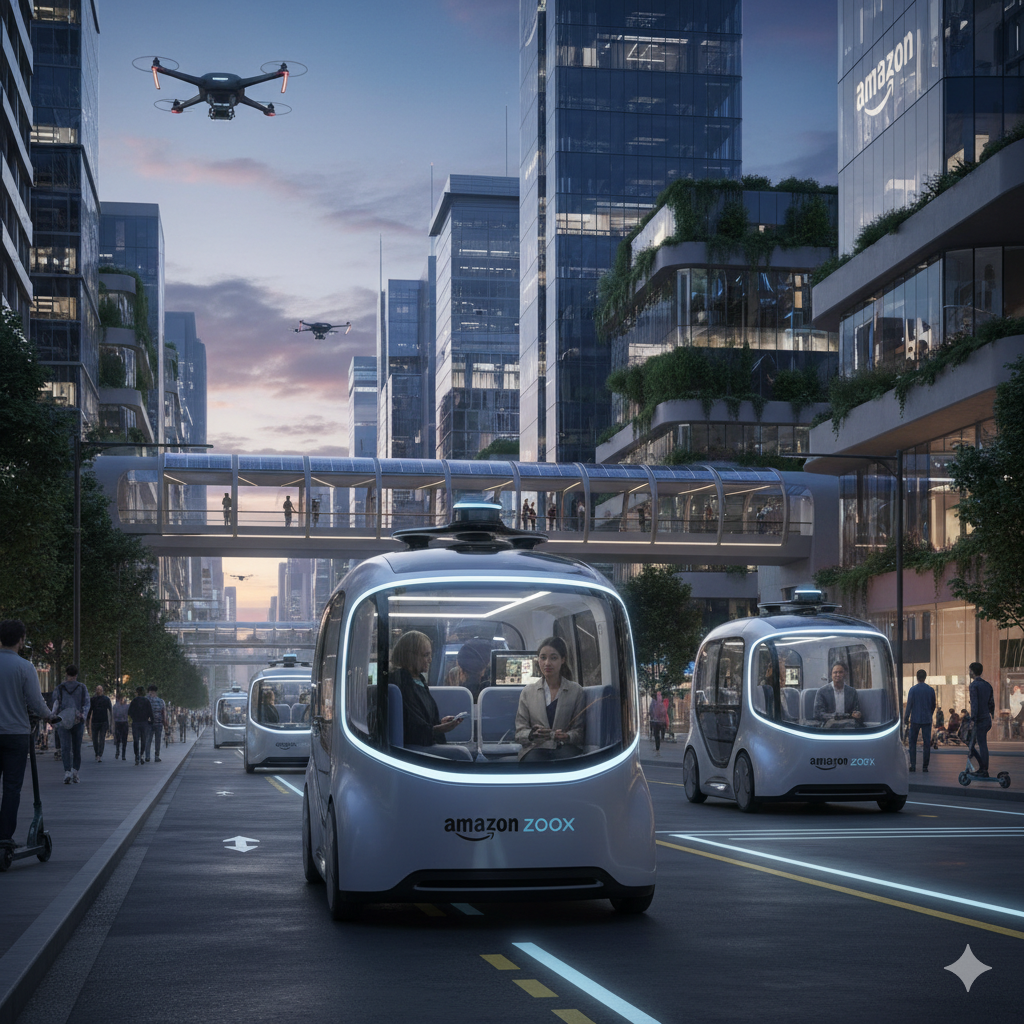
Robotaxis & Telepathic AI: The Future Rolls In
Zoox on the Strip Amazon’s Zoox has launched its driverless pods on the Las Vegas Strip. These four-seat shuttles skip the wheel and pedals entirely, looking more like rolling lounges than cars. Unlike Waymo’s retrofitted SUVs or Tesla’s cab-ready Model 3s, Zoox is all-in on vehicles designed purely for autonomy. Alterego’s Silent Speech Device Meanwhile, Boston startup Alterego has debuted a wearable that lets you “talk” to AI without speaking. It reads tiny neuromuscular signals from the jaw before words are voiced, then replies through bone-conduction audio. No implants, no thought-reading—just silent, hands-free interaction with machines. Why It Matters Both inventions strip away familiar mediators—steering wheels, vocal cords—and replace them with direct interfaces. Zoox imagines transport without drivers; Alterego imagines communication without sound. Together, they hint at a future where cities move differently and conversations happen invisibly. The promise is thrilling, but the questions of privacy, safety, and ethics are only beginning. Takeaway The world of tomorrow may not shout or steer—it may glide and whisper. “Hey, would you like to learn more about us? Please visit our website; here’s the link.” Step into the future with us, KhalifAItelligence.com

Anthropic Rockets to $183B Valuation with $13B Series F
Anthropic has wrapped up a massive Series F funding round, pulling in $13 billion and pushing its valuation to $183 billion post-money. The round was led by ICONIQ, alongside Fidelity Management & Research and Lightspeed Venture Partners, underscoring growing confidence in Anthropic’s place at the center of the AI race. The investor list reads like a who’s who of global finance—Altimeter, Baillie Gifford, BlackRock-affiliated funds, Blackstone, Coatue, D1 Capital Partners, General Atlantic, General Catalyst, GIC, Goldman Sachs Alternatives, Insight Partners, Jane Street, Ontario Teachers’ Pension Plan, Qatar Investment Authority, TPG, T. Rowe Price, WCM Investment Management, and XN all took part. Krishna Rao, Anthropic’s CFO, pointed to the “exponential growth in demand” from both Fortune 500 firms and AI-first startups, saying the raise reflects investor confidence in Anthropic’s momentum. And that momentum is eye-popping: Claude launched in March 2023, and by early 2025 revenue had already hit a $1 billion run rate. By August this year, that number had quintupled to more than $5 billion, cementing Anthropic’s status as one of the fastest-growing tech companies ever. Much of this surge has been driven by the popularity of Claude Code, rolled out in May 2025, which is already generating over $500 million in annualized revenue. Meanwhile, Anthropic’s enterprise and consumer products have been adopted by over 300,000 business customers, with large accounts multiplying nearly sevenfold in just 12 months. For ICONIQ, the deal is about more than raw numbers. Partner Divesh Makan described Anthropic as “combining research excellence, technological leadership, and relentless focus on customers,” highlighting Claude’s reputation as a trustworthy and dependable AI system. The new funding will be channeled into scaling enterprise capacity, deepening Anthropic’s safety and alignment research, and expanding internationally—furthering its mission to build interpretable, reliable, and steerable AI platforms. Step into the future with us, KhalifAItelligence.com